Table of Contents
Critical Temperatures for Magnets
Click here to download the critical temperatures for magnets PDF document.
Neodymium Iron Boron Magnets Properties (NdFeB)
| Common Name | Rare earth (or) Neo’s |
| Released onto the market | 1983 |
| Magnetic output | Very high strength to cost ratio |
| Resistance to demagnetisation | Very high |
| Relative cost | Medium |
| High temperature tolerance | Poor (Although high temp grades are available) |
| Corrosion resistance | Poor |
| Surface finish | Can be plated in a range of finishes |
| Physical characteristics | Very hard and brittle |
| Workability | Extremely difficult to machine or drill |
| Uses | Widely used throughout many industries |
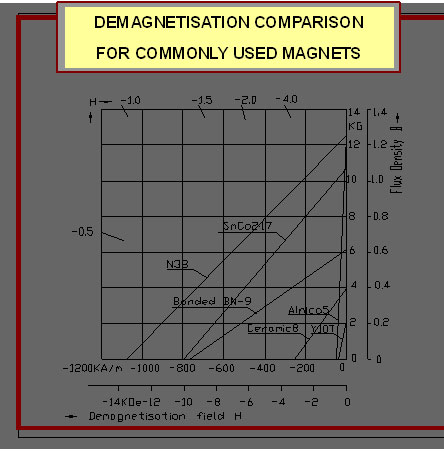
Click here for a demagnetisation comparison graph
Sintered NdFeB Magnetic Technical Specifications
Click here to view the Sintered NdFeB Technical Specifications chart
Ferrite Magnets Properties
| Common Name | Ceramic magnets |
| Released onto the market | Early 1950’s |
| Magnetic output | Medium |
| Resistance to demagnetisation | High |
| Relative cost | Very cost effective (Low priced) |
| High temperature tolerance | Good |
| Corrosion resistance | Excellent |
| Surface finish | Smooth (Dark grey in colour) |
| Physical characteristics | Very hard and brittle |
| Workability | Extremely difficult to machine or drill |
| Uses | Widely used throughout many industries |
Samarium Cobalt Magnets Properties (SmCo)
| Released onto the market | 1970 |
| Magnetic output | Very high strength |
| Resistance to demagnetisation | High |
| Relative cost | High |
| High temperature tolerance | Excellent stability over a wide range |
| Corrosion resistance | Excellent |
| Surface finish | Can be plated in a range of finishes |
| Physical characteristics | Very hard and brittle |
| Workability | Extremely difficult to machine or drill |
| Uses | Used when high magnetic strength is required in high temperatures |
Click here for a demagnetisation comparison graph
| Component metals | Aluminium, Nickel and Cobalt |
| Released onto the market | 1940’s |
| Magnetic output | Medium strength |
| Resistance to demagnetisation | Poor |
| Relative cost | Less cost effective as better alternatives have become available |
| High temperature tolerance | Excellent stability over a wide range |
| Corrosion resistance | Good |
| Surface finish | Often painted red |
| Physical characteristics | Often has a rough cast finish |
| Workability | Can be machined and drilled with difficulty |
| Uses | Used in high temperature environments |
Click here for a demagnetisation comparison graph
Extruded Flexible Magnetic Strip Properties
| Common Name | Mag Strip |
| Magnetic Output | High strength to cost ratio |
| Resistance to demagnetisation | Very high |
| Relative cost | Low cost |
| High temperature tolerance | Good |
| Corrosion resistance | Poor on solvents (But good on many other chemicals) |
| Surface finish | Can be plain or coated with adhesive |
| Physical characteristics | Soft and flexible |
| Workability | Can be cut with ease |
| Uses | Widely used for promotional display boards |